
Strongly interacting electrons in two-dimensional systems can spontaneously break translational symmetry, forming a periodic Wigner crystal. Although these crystals have been realized in several platforms, experimental studies of their collective many-body excitations in the absence of a magnetic field have not been demonstrated. Here we access this regime optically by uncovering Wigner crystal polarons, which are hybrid light–matter quasiparticles that arise from the dressing of excitons by the collective excitations of the Wigner crystal. These polarons manifest as optical resonances in the cryogenic reflectance spectra of a charge-tunable WSe2 monolayer, appearing concurrently with previously identified exciton umklapp transitions. In contrast to the latter, the energies of Wigner crystal polarons are governed not only by the electronic lattice constant but also by their hybridization with attractive exciton–polarons, whose strength is controlled by electronic interactions. These many-body excitations provide an optical interface to the spin state of the Wigner crystal that, as we demonstrate, can be controlled both magnetically and optically. Our work establishes layered materials as a platform for exploring dynamical impurity dressing by strongly correlated electronic orders. Electron Wigner crystals have been observed in atomically thin transition metal dichalcogenides, but their collective excitations have not been shown. Now the signatures of these excitations are revealed in the optical spectra of a charge-tunable monolayer semiconductor.
science
Spectroscopy of Wigner crystal polarons in an atomically thin semiconductor
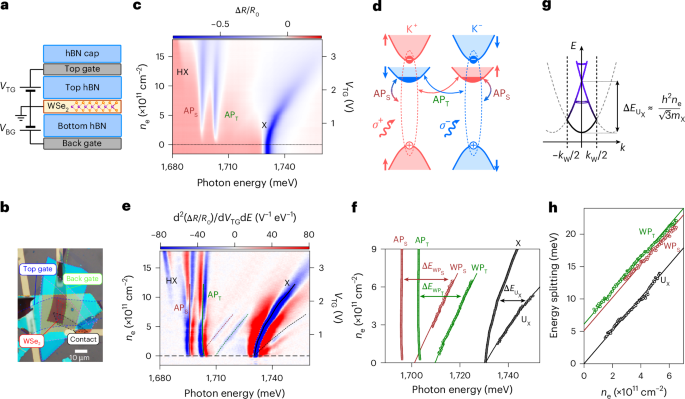
Understanding the ground states and collective excitations of strongly correlated electronic phases lies at the heart of condensed-matter physics. A paradigmatic example of such a phase is the Wigner crystal (WC), which forms when Coulomb interaction... [43672 chars]