health

Explore the latest health stories, updates, and comprehensive coverage.
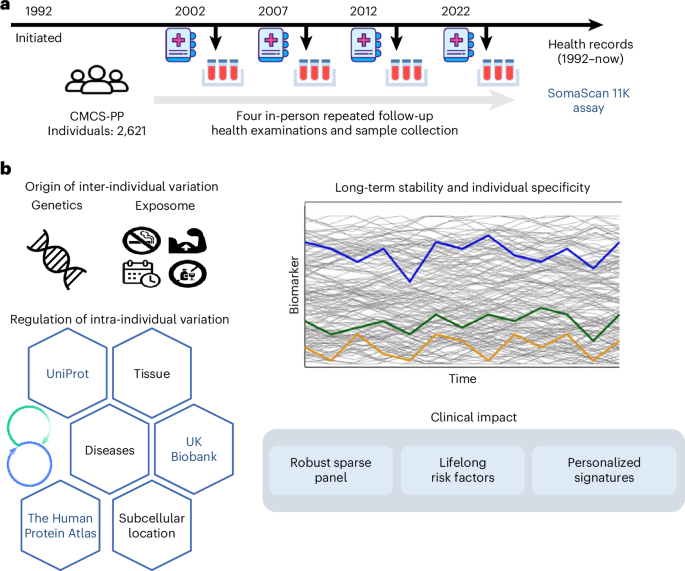
Understanding whether blood markers maintain stable, individual-specific levels over time is central to systemic homeostasis and precision medicine. While the stability of routine biomarkers is well-established, the long-term dynamics of the broader circulating proteome remain poorly defined. Here we present a 20-year longitudinal cohort study of 1,298 individuals from middle-to-later adulthood to older age. By profiling 10,776 protein markers across four time points, we reveal substantial heterogeneity in temporal stability across the proteome, a pattern distinct from the relatively uniform stability of routine markers. We show that protein stability is largely conserved across sex and life stages, while identifying specific shifts that indicate life-stage transitions. Highly stable proteins are strongly shaped by genetic factors and are enriched for circulation-mediated physiological functions, such as immune regulation. Using these stable proteins as biological fingerprints, we translate our findings into clinical practice. We validated our results using the UK Biobank to ensure robust clinical translation, specifically by (1) defining a sparse, reliable panel that improves biological age prediction and its association with ageing-related outcomes; (2) distinguishing lifelong-stable from volatile risk biomarkers for cardiovascular disease and dementia; and (3) identifying 21 proteins that define personalized homeostatic baselines. Importantly, deviations from these baselines independently predicted mortality, reflecting early disruption of homeostasis across metabolic, immune and tissue-remodelling axes. Together, this work establishes the first comprehensive map of long-term proteomic stability, providing a foundation for systemic homeostasis research and blood-based precision medicine. Using data from 2,621 individuals across 20 years of their lifetime, this analysis sheds light on how protein marker profiles change over time and how this change is related to physiological function, as a tool to monitor ageing and develop personalized risk factors.

A person’s rigid attempts to avoid anxious feelings might increase their likelihood of developing an anxiety disorder. New research suggests that learning to accept and adapt to psychological distress could be a key component in treating mental health conditions.

US News: Two people have been bitten by beavers at a popular Maryland state park in less than two weeks, prompting officials to partially close the area while .