
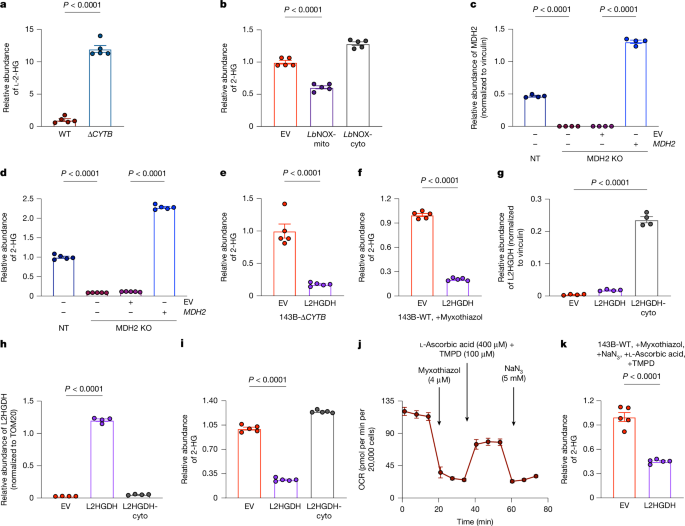
l-2-Hydroxyglutarate (l-2-HG) is a low-abundance metabolite in mammals because the mitochondrial enzyme l-2-HG dehydrogenase (L2HGDH) oxidizes l-2-HG to 2-oxoglutarate (2-OG) to prevent its accumulation1. In humans, a lack of L2HGDH activity leads to l-2-HG accumulation and causes l-2-hydroxyglutaric aciduria2. Thus, l-2-HG is often classified as a toxic metabolite2–5. However, whether l-2-HG has any physiological function is unclear. Here we investigate whether l-2-HG qualifies as a physiological signalling metabolite by testing three criteria: regulated levels, defined molecular targets and a measurable physiological function. We report that an increase in mitochondrial NADH/NAD+ ratio drives malate dehydrogenase 2 (MDH2) to reduce 2-OG into l-2-HG. Moreover, L2HGDH oxidizes l-2-HG back to 2-OG in the mitochondrial matrix without requiring a functional electron transport chain. Through proteome integral solubility alteration assays, we show that the KDM4 family of H3K9 demethylases are l-2-HG-responsive targets. l-2-HG represses the nascent transcription of specific genes in mouse embryonic stem cells and increases H3K9me3 (a repressive histone mark) at these loci. In vivo, early embryonic L2HGDH overexpression in mice systemically reduces l-2-HG levels, impairs postnatal growth, causes mortality and produces selective functional and histological renal vulnerabilities. In postnatal kidneys, this reduction in l-2-HG causes H3K9me3 loss at L1MdTf retrotransposons and their derepression, which coincides with the activation of the integrated stress response and inflammation pathways. Our findings establish mitochondrial l-2-HG as a physiological signalling metabolite and indicate that metabolites previously regarded as toxic may also have crucial physiological functions. l-2-Hydroxyglutarate is identified as a legitimate physiological signalling metabolite, and control of its levels is essential for postnatal growth and survival and correct renal development and function.
science
Mitochondrial l-2-hydroxyglutarate is a physiological signalling metabolite
Cell culture, drug treatment and fractionation
143B cells were cultured in Dulbecco’s modified Eagle medium (DMEM) (Gibco, 11965-126) supplemented with 10% Nu-serum IV (Corning, 355504), 10 mM HEPES (Corning, 25-060-CI), 1× GlutaMAX (Gibco, 35050061)... [47094 chars]