
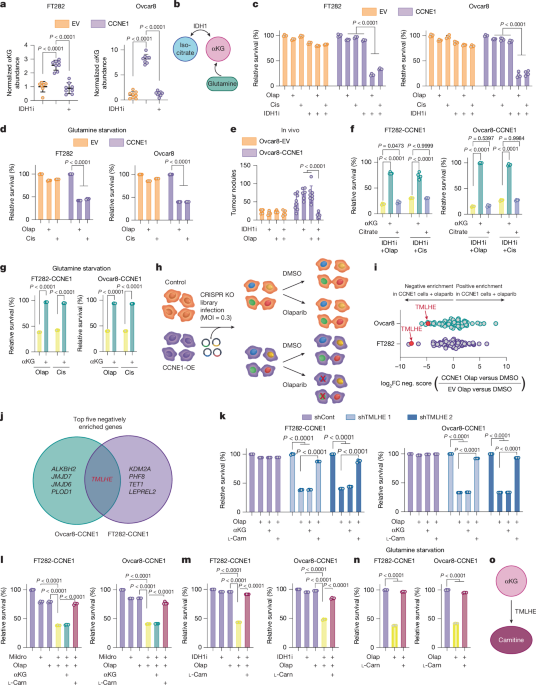
Homologous recombination (HR) deficiency increases sensitivity to DNA-damaging agents that are commonly used to treat cancer1. In HR-proficient cancers, the metabolic mechanisms that drive response or resistance to DNA-damaging agents remain unclear. Here we have identified that depletion of α-ketoglutarate (αKG) sensitizes HR-proficient cells to DNA-damaging agents by metabolic regulation of histone acetylation. αKG is required for the activity of αKG-dependent dioxygenases2 (αKGDDs), and previous work has focused almost exclusively on the demethylase functions of αKGDD. Using a targeted CRISPR knockout library consisting of 64 αKGDDs, we discovered that trimethyllysine hydroxylase epsilon (TMLHE), the first and rate-limiting enzyme in de novo carnitine synthesis, is necessary for the survival of HR-proficient cells in the presence of DNA-damaging agents. Unexpectedly, αKG-mediated TMLHE-dependent carnitine synthesis was required for histone acetylation and was non-redundant with other nucleo-cytosolic acetyl-CoA-generating pathways. The increase in histone acetylation by means of the αKG–carnitine axis promoted HR-mediated DNA repair through site-specific histone acetylation. Finally, we observed a positive correlation between TMLHE and histone acetylation in patient samples and found that high TMLHE or acetylcarnitine correlates with worse progression-free survival in patients treated with DNA-damaging agents. This study demonstrates for the first time, to our knowledge, that αKG affects site-specific histone acetylation and provides a mechanism of HR proficiency through carnitine synthesis. Moreover, these data provide a metabolic avenue for inducing HR deficiency and promoting sensitivity to DNA-damaging agents. The metabolite αKG promotes carnitine synthesis and increases site-specific histone acetylation, thereby promoting homologous recombination-mediated DNA repair, which has potential implications for chemoresistant cancers.
Cells and culture conditions
Ovcar8, JHOS4, Uwb1.289 and PEO1 cells were a gift from Benjamin Bitler (University of Colorado). Ovcar8 cells were cultured in RPMI 1640 medium (Gibco, 11875119) supplemented with 5% fetal bovine serum (FBS; BioWest, S16... [48442 chars]