
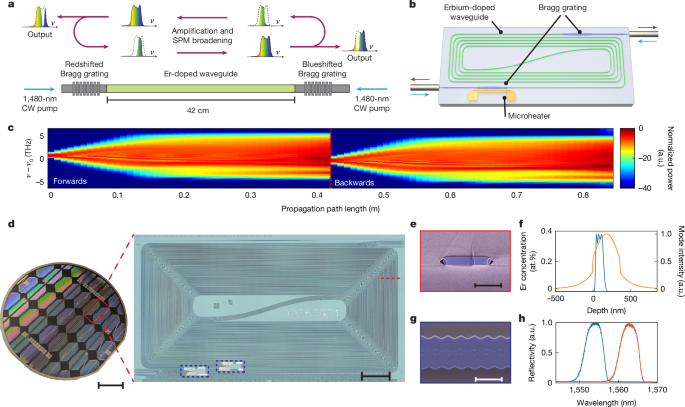
Ultrafast lasers have led to numerous advances across science and technology: they enabled corneal surgery1, revealed chemical reaction dynamics2 and triggered the development of optical atomic clocks3. Over the past decades, extensive efforts have aimed to realize mode-locked lasers based on photonic integrated circuits (PICs) that are compact, manufactured at wafer scale and are compatible with further on-chip functionalities4–6. Yet, existing demonstrations to date lack the pulse energy required to drive nonlinear processes, such as supercontinuum generation. Here we demonstrate a mode-locked laser that overcomes this challenge through the use of erbium-ion-implanted silicon nitride PICs7. The laser is based on the Mamyshev oscillator architecture8, in which alternating spectral filtering and self-phase modulation enable mode-locking and can support large nonlinear phase shifts9. It operates without external seeding, delivering a 176-MHz pulse train with nanojoule pulse energy, comparable with fibre lasers and exceeding previous PIC-based sources by two orders of magnitude. The output exhibits high coherence, can be linearly compressed to 147 fs and can directly drive a 1.5-octave-spanning supercontinuum in a Si3N4 waveguide, without any further amplification. A compact terahertz time-domain spectrometer driven by this source achieved a bandwidth of 5 THz and a 90-dB dynamic range. We demonstrate its application in non-contact chemical analysis and inspection. Our results show the potential of an integrated ultrafast laser, with applications ranging from chip-scale frequency metrology to portable spectroscopy systems. A Mamyshev oscillator mode-locked laser compactly integrated on a photonic-chip delivers nanojoule, femtosecond pulses.
Ultrafast lasers have led to numerous advances across science and technology: they enabled corneal surgery1, revealed chemical reaction dynamics2 and triggered the development of optical atomic clocks3. Over the past decades, extensive efforts have a... [1400 chars]