
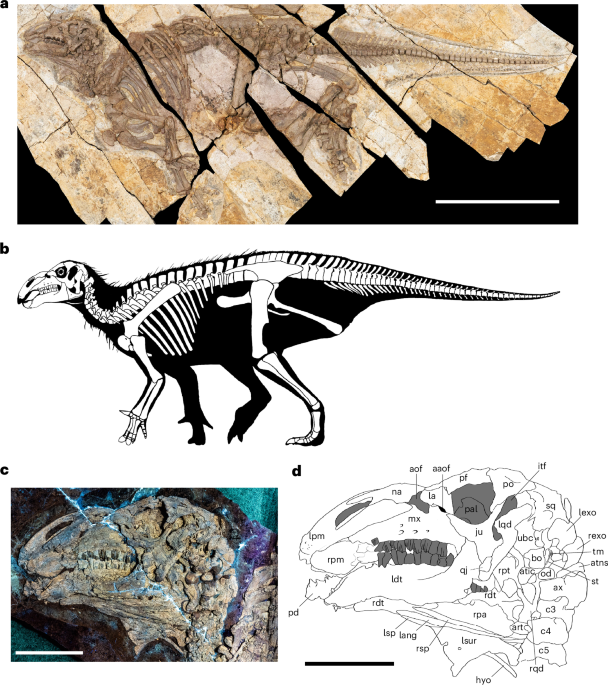
The near-complete and articulated skeleton of a new iguanodontian dinosaur, Haolong dongi gen. et sp. nov., from the Lower Cretaceous of northeastern China, preserves exquisitely fossilized skin. The integument includes large overlapping scutate scales along the tail and tuberculate scales around the neck and thorax markedly different from the scale pattern described in other iguanodontians. Remarkably, these scales are interspersed with cutaneous spikes preserved at the cellular level. Tomographic and histological analyses reveal a hollow, cylindrical structure composed of a cornified stratum corneum overlying a pluristratified epidermis with keratinocytes preserved to the level of nuclei, surrounding a porous central dermal pulp. These spikes differ structurally from known protofeathers in non-avian dinosaurs and scaly spines in extant squamates, suggesting a distinct evolutionary origin. Their morphology and distribution imply a primary role in predator deterrence, with potential secondary functions in thermoregulation or mechanoreception. This discovery provides unprecedented insight into the microanatomy of non-avian dinosaur skin and highlights the complexity of skin evolution in ornithischian dinosaurs. A juvenile iguanodontian from the Lower Cretaceous of China preserves both spikes and scales in its skin that are different from integumentary structures in either non-avian dinosaurs or extant squamates and may have had a defensive function.
science
Cellular-level preservation of cutaneous spikes in an Early Cretaceous iguanodontian dinosaur
Bell, P. R. Standardized terminology and potential taxonomic utility for hadrosaurid skin impressions: a case study for Saurolophus from Canada and Mongolia. PLoS ONE 7, e31295 (2012).
Bell, P. R. in Hadrosaurs (eds Eberth, D. A. & Evans, D. C.) 572–... [6771 chars]