
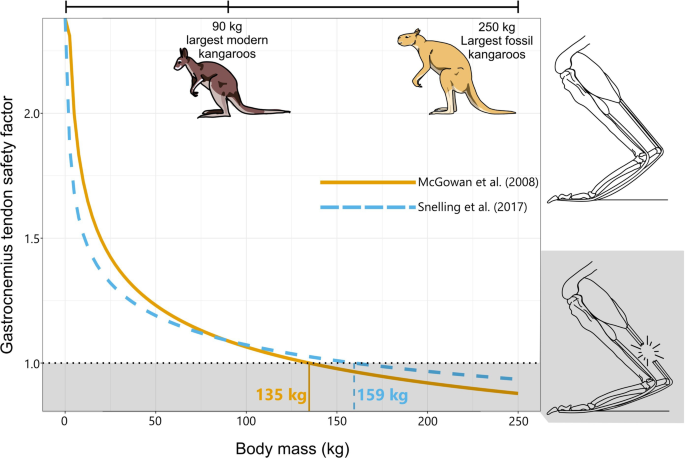
The locomotor abilities of animals depend upon their body size. Today, kangaroos are the largest hopping mammals, but some of their Pleistocene relatives were larger still—more than twice as heavy as any modern kangaroo. So, is there an upper size limit of bipedal hopping? Previous analyses have recovered an upper limit of ~ 140–160 kg based on allometry, but have suggested that incorporating changes in hindlimb scaling patterns among giant species would alter these conclusions. Here, we test this proposal by integrating scaling data from modern kangaroos with direct observation of the hindlimb bones of giant fossil kangaroos. We test two potential limiting factors on hopping—bone strength, and tendon size. We find that (a) the metatarsals of giant kangaroos would be capable of resisting the bending moments involved in hopping, and (b), the calcanea (heel bones) of giant kangaroos could accommodate tendons large enough to resist the loads generated during hopping. While hopping may not have been their primary mode of locomotion, our findings suggest that it may have formed part of a broader locomotor repertoire, for example for short bursts of speed.
science
Biomechanical limits of hopping in the hindlimbs of giant extinct kangaroos
Here we tested the hypotheses that hopping in extinct giant kangaroos may have been limited by (a) metatarsal IV bone strength or (b) strength of the ankle extensor (gastrocnemius) tendon. The results of this study suggest neither metatarsal nor gast... [33446 chars]